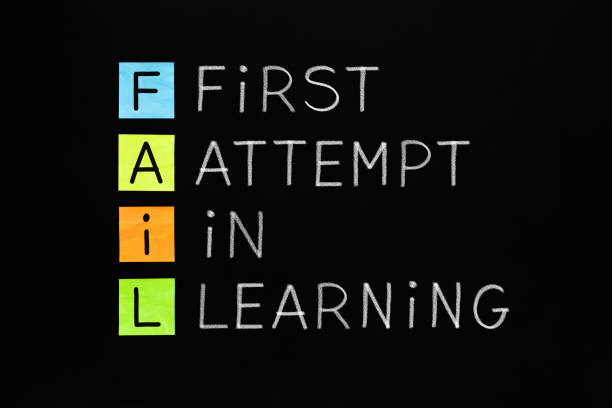
We tell our students that failure is a step in learning, but how often do we explain to them the value of failure, or more importantly, the importance of making mistakes? We train our students to get problems right, rather than to learn from their mistakes. We give students assignments and mark off what is incorrect. When assignments are handed back, students see what is wrong, but never understand why it’s wrong and what they need to do to improve. Mistakes are a necessity in the process of learning and growing. However, if we never take time to revisit mistakes, nothing is learned.

Students are afraid of failure, because they see failure as something that identifies them. And let’s be honest, no one wants to be identified as a failure. When students make too many mistakes, they begin to believe that those mistakes tell a story of who they really are. Rock Thomas has an incredible story that I share with my students every year (I will include the link below). In his story he talks about the power of the “I am..” statement. He says, “What follows ‘I am’ follows you.” When students see failure as an identity, they have an “I am a failure” mindset. We need to be better at teaching students that failure and making mistakes is a part of learning. Instead of giving them papers marked up in red, we need to give them opportunities to correct their mistakes to encourage learning from their mistakes.
Rita Pierson has an incredible Ted Talk where she talks about how every student needs a champion. In her talk, she talks about a young boy in her class who struggled with math. She gave him an assignment where he missed all but two problems. Instead of focusing on all of the incorrect answers, Rita rejoices with the student on the two that he got right. She uses it as an opportunity for learning and growth. She says, “It’s not all bad. We just have work to do.” Instead of showing what students did wrong, we need to capitalize on what they do right and use their mistakes as learning opportunities.
Jocko Willink is a former Navy Seal, author of multiple books, a podcaster, and CEO of Echelon Front. In one of his podcasts he talks about a specific mindset to handle disappointment, discouragement, or bad news. He tells a story of how one of the guys he works with always says one word when given bad or disappointing news, and that word is “Good”. The mindset of “Good” says, “I got something wrong? Good! That means I have an opportunity to practice and get better.” Why aren’t we instilling this ideology into our students?
The other day, I had a former student come into my classroom and share her woes of her not getting straight “A’s”. I asked her if she was able to redo any of the work she got wrong, and she said “Yes”, but she could only earn half the points back. I was perplexed when I heard this. If a student is willing to go back and make corrections to assignments, tests, quizzes, etc., why wouldn’t they earn full points back for the ones she got right? Again, this doesn’t support the idea that mistakes are stepping stones to learning.
I am a teacher that wants to connect what I teach to real world concepts. In the real world, if you make a mistake, you are usually given the opportunity to correct your errors. For example, if I speed and get caught, I might get a ticket or I might get a warning. Either way, I don’t lose my car, my license, or my ability to drive. Now, I understand that repeated offenses might cause me to lose one or all of those things. However, I am given the opportunity to correct my mistakes and learn from my poor choices. At work, I might make a mistake in grading or how I deal with a situation with a student. Depending on the severity, I am shown what I did wrong and given the opportunity to make corrections to my actions and choices. All in all, there is no big red pen in life that marks off our mistakes without giving us the opportunity to make changes and corrections.

Here’s the reality of learning – We make mistakes until we get it right. Sometimes we make numerous mistakes until we get it right. Other times, it only takes one mistake for us to get it right. Either way, mistakes MUST happen in order for us to learn. Instead of pointing out the mistakes and wrong answers to our students, maybe we should take the opportunity and help our students learn from their errors and mistakes. I tell my class every year, it is easy to get straight “A’s” in my class. All they need to do is go back and make corrections or redo assignments that they did poorly on. I honor a student’s attempt at making corrections to their work with full points. Not to mention, the more they do it, the better they will get at it.
Let’s reconsider how we handle academic mistakes from our students. Let’s capitalize on the learning opportunities that come from those mistakes. And instead of marking up students’ papers with a red pen and handing them back, let’s give students the opportunity to learn from their mistakes by making corrections to the problems or assignments they got wrong, and allow them to get help in the areas they struggled.
Links:
 Welcome To The Classroom